Hi, I am a second-year PhD student in Electrical & Computer Engineering at Seoul National University. I am currently a member of the Computer Vision Lab, advised by Prof. Bohyung Han. My research focuses on deep learning and computer vision, with a particular interest in vision-language models. My goal is to build models that are not only powerful and practical, but also intuitive and impactful in helping people.
I am currently open to research internship opportunities, particularly in areas related to computer vision, image/video enhancement and multimodal learning. If you would like to connect, collaborate, or discuss potential opportunities, please feel free to contact me at hij1112 at snu.ac.kr.
Generative image super-resolution produces visually realistic high-resolution images, but may also introduce hallucinations by adding unsupported content or altering existing details. Because existing super-resolution metrics fail to measure whether generated details remain grounded in the reference image, we present a hallucination assessment technique based on bidirectional visual question answering (VQA), which we term VQA-based Hallucination Assessment (VHA). The proposed approach uses a vision-language model (VLM) to determine whether the semantic content and low-level visual evidence in a super-resolved image are supported by its ground-truth counterpart. To this end, it constructs question–answer pairs from each image and evaluates them on both images. Discrepancies between the resulting scores in both directions reveal missing or altered ground-truth information and unsupported additions. However, obtaining these scores requires computationally expensive VLM inference. We therefore develop VHA+, a learned, lightweight model that directly predicts VHA scores from ground-truth and super-resolved image pairs. We construct a hallucination benchmark, VHA-bench, through a human study and show that both VHA and VHA+ correlate highly with human judgments of hallucination.
TL;DR: We present VHA, a VQA-based metric that uses bidirectional visual question answering to assess whether generated super-resolution details remain grounded in the reference image.
CVPR 2026
Beyond the Ground Truth: Enhanced Supervision for Image Restoration
Deep learning-based image restoration has achieved significant success. However, when addressing real-world degradations, model performance is limited by the quality of ground-truth images in datasets due to practical constraints in data acquisition. To address this limitation, we propose a novel framework that enhances existing ground truth images to provide higher-quality supervision for real-world restoration. Our framework generates perceptually enhanced ground truth images using super-resolution by incorporating adaptive frequency masks, which are learned by a conditional frequency mask generator. These masks guide the optimal fusion of frequency components from the original ground truth and its super-resolved variants, yielding enhanced ground truth images. This frequency-domain mixup preserves the semantic consistency of the original content while selectively enriching perceptual details, preventing hallucinated artifacts that could compromise fidelity. The enhanced ground truth images are used to train a lightweight output refinement network that can be seamlessly integrated with existing restoration models. Extensive experiments demonstrate that our approach consistently improves the quality of restored images. We further validate the effectiveness of both supervision enhancement and output refinement through user studies.
TL;DR: We present a supervision enhancement framework that generates high-fidelity ground truths by fusing suboptimal references with super-resolved details via frequency-domain mixup.
CVPR 2026
Learning to Translate Noise for Robust Image Denoising
Image denoising techniques based on deep learning often struggle with poor generalization performance to out-of-distribution real-world noise. To tackle this challenge, we propose a novel noise translation framework that performs denoising on an image with translated noise rather than directly denoising an original noisy image. Specifically, our approach translates complex, unknown real-world noise into Gaussian noise, which is spatially uncorrelated and independent of image content, through a noise translation network. The translated noisy images are then processed by an image denoising network pretrained to effectively remove Gaussian noise, enabling robust and consistent denoising performance. We also design well-motivated loss functions and architectures for the noise translation network by leveraging the mathematical properties of Gaussian noise. Experimental results demonstrate that the proposed method substantially improves robustness and generalizability, outperforming state-of-the-art methods across diverse benchmarks.
TL;DR: We present a robust denoising framework that simplifies the removal of complex real-world noise by translating it into Gaussian noise.
CVPR 2024
Robust Image Denoising through Adversarial Frequency Mixup
Image denoising approaches based on deep neural networks often struggle with overfitting to specific noise distributions present in training data. This challenge persists in existing real-world denoising networks, which are trained using a limited spectrum of real noise distributions, and thus, show poor robustness to out-of-distribution real noise types. To alleviate this issue, we develop a novel training framework called Adversarial Frequency Mixup (AFM). AFM leverages mixup in the frequency domain to generate noisy images with distinctive and challenging noise characteristics, all the while preserving the properties of authentic real-world noise. Subsequently, incorporating these noisy images into the training pipeline enhances the denoising network’s robustness to variations in noise distributions. Extensive experiments and analyses, conducted on a wide range of real noise benchmarks demonstrate that denoising networks trained with our proposed framework exhibit significant improvements in robustness to unseen noise distributions.
TL;DR: We present Adversarial Frequency Mixup (AFM), a novel training framework that enhances image denoising networks’ robustness to out-of-distribution noise.

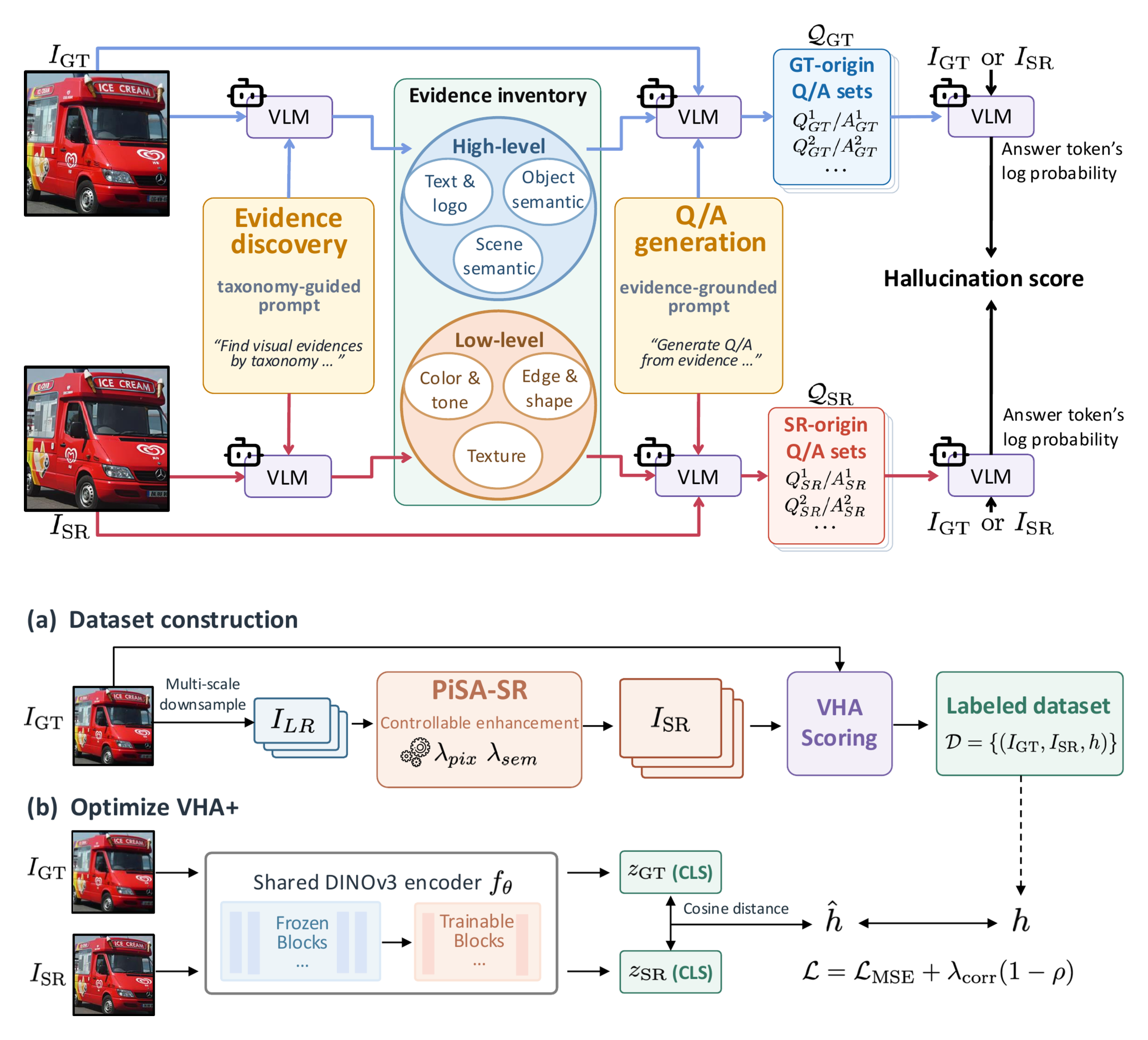 VHA: VQA-based Hallucination Assessment for Generative Image Super-ResolutionUnder Review , Oct 2026TL;DR: We present VHA, a VQA-based metric that uses bidirectional visual question answering to assess whether generated super-resolution details remain grounded in the reference image.
 Beyond the Ground Truth: Enhanced Supervision for Image RestorationIn Proceedings of the IEEE/CVF Conference on Computer Vision and Pattern Recognition (CVPR), Jun 2026TL;DR: We present a supervision enhancement framework that generates high-fidelity ground truths by fusing suboptimal references with super-resolved details via frequency-domain mixup.
 Learning to Translate Noise for Robust Image DenoisingIn Proceedings of the IEEE/CVF Conference on Computer Vision and Pattern Recognition (CVPR) Findings, Jun 2026TL;DR: We present a robust denoising framework that simplifies the removal of complex real-world noise by translating it into Gaussian noise.
 Robust Image Denoising through Adversarial Frequency MixupIn Proceedings of the IEEE/CVF Conference on Computer Vision and Pattern Recognition (CVPR), Jun 2024TL;DR: We present Adversarial Frequency Mixup (AFM), a novel training framework that enhances image denoising networks’ robustness to out-of-distribution noise.